
Experiences from HBO to university
Are you curious about the experiences of former HBO students who have chosen to follow a Master's programme at Radboud University? Read their stories below.
Sophie is doing the Master's Language Variation and Multilingualism

The pre-Master's was mostly a lot of work. I was a bit nervous about the level of the teaching material, but this was doable.
- Previous education
- English teacher training
Sophie started a pre-Master's programme in Linguistics after completing her English teacher training at HBO. Now she is doing the Master's Language Variation and Multilingualism.
Why did you decide to do a Master's after your HBO?
After my English teacher training, I started a (pre-)Master's programme because after working as a teacher for a while, I missed studying. I also wanted to expand my options by obtaining a Master's degree and thus being able to teach at more different educational institutions. I also wanted to gain more knowledge about designing teaching materials and good tests.
How do you feel about the transition from HBO to a research university?
The transition from HBO to a university was not an easy one for me. The differences that struck me the most were those of the study advisor and contact hours. You now had a study advisor instead of an 'SLB'er'. However, you always had to make an appointment yourself and prepare these appointments well so that you had specific questions. The division between lectures and worklectures was also new. At my HBO education we always had classroom lessons with many contact hours. Studying at a university is a lot more individual and you are responsible for how you plan your time. If you have a lecture on Monday afternoon, you can choose to do all the preparation on the same morning, but you can also spread it out and do it in the week before. I don't recommend going to a lecture unprepared, that will only cause confusion and more work afterwards. You are responsible for collaboration yourself, I personally really enjoyed going to the university library with fellow students and studying together.
How do you experience the level of the pre-Master's?
The pre-Master's was mostly a lot of work. I was a bit nervous about the level of the teaching material, but this was doable. You take courses from different years of the Bachelor's programme. These can therefore be courses from the third year, but also from the first year. This often overlaps a lot with knowledge you acquired during your HBO bachelor's degree or internship. However, the pace was faster and there was more work pressure in this way. I myself had time for a part-time job, but no more than two days a week. And even then I still got tangled up with time. Still, my message is: if you work hard, you don't have to doubt yourself. You can handle it!
What appeals to you most about the university and why?
What appeals to me about the university is that you are given the opportunity to (partly) compose your own programme and that you can therefore fully develop. All kinds of activities are also organized outside your lectures and there is always something to do. I always enjoy being on campus.
Which Master's will you follow after the pre-Master's? And what do you want to do with that Master's degree?
At the moment I am following the Master's Language and Communication Coaching. This name has now been changed to Language Variation and Multilingualism. I would like to work with a combination of developing teaching materials and teaching.
Kim is following the pre-Master's Biomedical Sciences
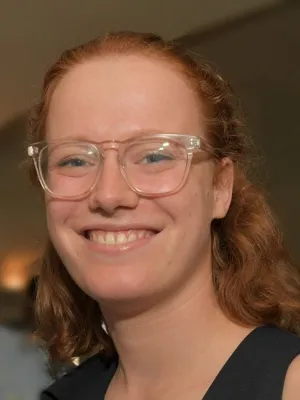
The great thing is that the pre-Master's class is a mix of different backgrounds, so you complement and support each other.
- Previous education
- Physiotherapy
After her HBO training in Physiotherapy, Kim started a pre-Master's programme. After this she will start with the Master's Biomedical Sciences.
Why did you decide to do a Master's after your HBO?
I chose to do a Master's after my HBO because I found the perspectives after my HBO bachelor too practical. I wanted to work more fundamentally. During my HBO bachelor I was always looking for the 'why?' behind the act and wanted to act as evidence-based as possible. This disappointed me during my HBO and with the work I studied for, so I applied for the pre-Master's.
How do you feel about the transition from HBO to a research university?
I moved to a strange city, a new school, but during the pre-Master's I did not feel alone. From the start I had to deal with committed people around me who guided me where necessary. You also have involved professors who are open to questions during and outside the classes. Then I had my fellow students, they too often came from HBO education and ran into the same things as me. The great thing is that the pre-Master's class is a mix of different backgrounds, so you complement and support each other.
How do you experience the level of the pre-Master's?
After the summer holidays I started taking the first lessons. Now, with some courses, you follow a kind of warm-up week or weeks, but the pace soon reached a speed appropriate for university courses and will not often go slower. This requires independence and good planning. Once I had mastered this and also got used to the amount of preparation that some subjects require, I still had to deal with the level of difficulty. Because I did not do the Bachelor's degree in Biomedical Sciences, I lacked knowledge, that's what this pre-Master's programme was preparing me for, to make up for it. However, while taking the courses, I noticed that I still had some knowledge gaps. The difficulty of the courses directly depends on how thoroughly and when I filled in the knowledge gaps. Independence and planning also came into play here.
What appeals to you most about the university and why?
I chose Radboud University instead of other Dutch universities because I think Nijmegen is a nice city and friends have had great study experiences here. I heard those positive stories a lot less about my HBO education, for example. I also want to settle down in Nijmegen, so finding a (pre-)Master's here that suited me was icing on the cake.
Which Master's will you follow after the pre-Master's? And what do you want to do with that Master's degree?
I will do the Master's in Biomedical Sciences after my pre-Master's with the specialisation in Medical Neuroscience. When I have obtained my Master's degree, I see myself doing research into neurodevelopmental disorders (including ADHD) in women, because within this branch the woman-specific knowledge is limited. I also see myself doing research into both early diagnosis and prognosis of neuromuscular disorders (including muscle diseases).
Zoë is doing the Master's Commercial Communication
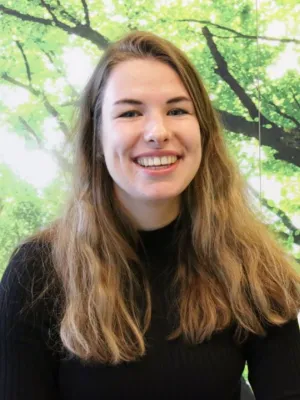
I spend a lot of time on my studies, but I can have a job of about 7 hours a week on the side.
- Previous education
- HBO Bachelor Communication Science
After the HBO Bachelor's in Communication Science, Zoë started the pre-Master's programme in Communication Science. She is now following the Master's specialisation in Commercial Communication.
Why did you decide to do a Master's after your HBO?
I started a Master's after my HBO education, because I didn't have much trouble with the level of my HBO education nd I was curious whether I could handle a university Master's. I felt like I wanted to learn even more, have a little more challenge. In addition, I thought: if I want to try whether I could handle university, now is the time. Ideal, in fact, that this is possible in two years, via a pre-Master's and then the Master's, instead of having to follow an entire university Bachelor's. I also hope that with a university Master's degree I could be given more strategic tasks later in the professional field, instead of more executive tasks after a Machelor's degree.
How do you feel about the transition from HBO to a research university?
I went to the university in 2020, during the first year of corona. As a result, I may have a slightly different picture than other university students. I knew many more people at HBO, but there were no online classes yet. I thought the advantage of HBO was that I really had a class there, while the work groups differ at a university. This does mean that you get to know more people, but perhaps a little more superficially. The number of contact hours at the university is a lot less for me than with HBO education, so you are much more dependent on yourself and self-study. I do think it is important that self-study suits you and that it is useful if you can put yourself to work. Furthermore, I had thought beforehand that the university would not very personal, but I find the lecturers much more accessible than I had thought in advance. With my Master's programme, many students call the teacher by their first name. The university also sounds very big, but I still find the atmosphere very pleasant. In my case, the atmosphere is quite comparable to HBO education. Furthermore, logically, at a university the emphasis is more on theory than practice. I am happy every time we can make a more practical example or report, because I think I can do this better with my HBO background. There is always theory involved in practice, for example, in order to be able to substantiate examples from practice with literature. In the beginning it takes some getting used to, but in the end you will also understand the practice better. To be honest, I didn't expect that there would also be many group projects at a university, but I certainly spend as much time on group projects during my education as I did at HBO education.
How do you experience the level of the pre-Master's?
I have to admit that I had to get used to the pre-Master's a bit in the beginning. I was already used to putting my study first, but now I had to put more time and energy into the study than at higher professional education. It took me longer to understand the principle of various theories. Once you understand the theory, I think the courses are easy to follow. I especially had to get used to the scientific articles. I didn't understand what everything meant at first because I didn't know some English terms. During the pre-Master's you get used to the articles and you understand much better what function the parts of an article have and what, for example, is and isn't important to read for an exam. During my studies, the group projects also cost a lot of time, so it was important to me to be flexible with appointments during the week. So I do spend a lot of time on my studies, but I can have a job of about 7 hours a week on the side. I also have enough time for sports and for my social life.
What appeals to you most about the university and why?
What I think is a really good addition is that I now look at the world and my environment from a much broader, social perspective. My HBO and university studies have the same direction, but my HBO study was much more commercial, while my university study also contains more of a socially and socially responsible aspect. Because I chose the Commercial Communication specialisation, I now look at various communication issues from a commercial, but also more socially responsible point of view.
Which Master's will you follow after the pre-Master's? And what do you want to do with that Master's degree?
I have completed the pre-Master's in Communication Science and have been following the Master's in Communication Science for six months. After this I do expect to go into the professional field, I would prefer to work in the marketing communication department of a sports organization. In addition to executive tasks, I would like to think along about how we can best carry out certain campaigns. In this way I can both use the new knowledge of WO to think in a more strategic area and use my HBO skills to be more creative.
More experiences
Would you like to get in touch online with a student who is taking the (pre-)Master's of your choice?