


Research at HFML-FELIX
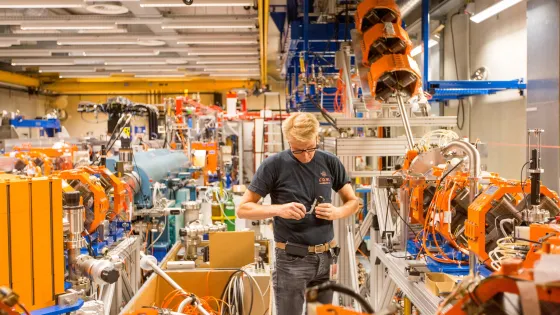
HFML-FELIX's high-field magnets and free-electron lasers enable scientists to expose matter to extreme conditions and drive it into previously inaccessible states and phases. Our dedicated research groups take full advantage of these possibilities by pushing the boundaries of science with their innovative research projects.
Research lines
Understanding the perplexing links between the quantum domain of individual atoms and the macroscopic world around us represents a monumental challenge in — but not limited to — physics and chemistry. The research agenda of HFML-FELIX aims to solve these grand challenges by studying fascinating phenomena at the detection and resolution limits available. Harnessing some of the world’s highest continuous magnetic fields and the unprecedented wavelength span and pulse energies of the suite of free-electron lasers are the key to discover, visualise, characterise and comprehend, for example, unidentified molecular structures and novel phases of matter.
The following topics broadly represent the research alignment and starting point of the new institution. This has been defined in close collaboration with the HFML-FELIX research team and the Institute for Molecules and Materials (IMM, Radboud University) and includes the many ongoing collaborations with national partners.
Overview of the research and engineering topic lines
- Mapping and manipulating quantum phases of matter
- Non-equilibrium phases of matter
- Dynamic self-organisation in soft molecular matter: Fundamental insights from extreme conditions
- Molecular structure identification and reactivity using advanced infrared spectroscopy
- Innovative instruments for advanced spectroscopy in high magnetic fields and with intense infrared/THz light
Research groups
HFML-FELIX has a strong in-house research programme subdivided into six accomplished research groups with a focus on the creative use of high magnetic fields, intense infrared and THz free-electron lasers, and the combination thereof to conduct a distinguishing research programme.
- Condensed Matter Physics
- Correlated Electron Systems
- FELIX Infrared and THz Spectroscopy
- Molecular Structure and Dynamics
- Semiconductors & Nanostructures
- Soft Condensed Matter & Nanomaterials
Condensed Matter Physics
The Condensed Matter Physics group uses the radiation of free electron laser FELIX to study both static and dynamic properties of matter. The goal of their research is to understand and control the relationship between the properties and structure of nanoscopic and molecular materials, with an emphasis on phenomena that occur on very short time scales. The underlying line is the interaction of photons with matter, the ambition is to achieve full control.
Staff scientists: Andrei Kirilyuk | Joost Bakker | Carl Davies
Correlated Electron Systems
The Correlated Electron Systems group focuses on a variety of topics like unconventional superconductivity, low-dimensional metals, quantum critical phenomena and quantum magnetism. Other topics of interest include magnetization, magnetostriction, thermopower, and the Nernst effect.
Staff scientists: Nigel Hussey
FELIX Infrared and THz Spectroscopy
The FELIX Infrared and THz Spectroscopy group develops and uses mass spectrometric techniques in combination with advanced infrared and terahertz spectroscopy. Their main scientific focus is in the field of astrochemistry, with the aim to understand the chemical evolution in astrophysical environments, such as interstellar star-forming regions or (exo-) planetary atmospheres, by simulating their conditions in the laboratory.
Staff scientists: Britta Redlich | Sandra Brünken
Molecular Structure and Dynamics
The Molecular Structure and Dynamics group combines and integrates mass spectrometry with IR spectroscopy, enabling them to obtain infrared spectral fingerprints for mass-selected ions inside the mass spectrometer. They apply infrared ion spectroscopy in various analytical challenges of identifying molecular structures of low-abundance compounds within complex mixtures, e.g. in biomarker discovery.
Staff scientists: Jos Oomens | Jonathan Martens | Giel Berden
Semiconductors & Nanostructures
The Semiconductors & Nanostructures group mostly studies quantum phenomena and transport in low-dimensional systems like graphene, oxide heterostructures and topological insulators. Other topics of interest include far infrared resonances (cyclotron and spin), and interband magneto-optics.
Staff scientists: Uli Zeitler | Steffen Wiedmann
Soft Condensed Matter & Nanomaterials
The Soft Condensed Matter & Nanomaterials group primarily conducts research on magnetic levitation, the alignment of molecular systems and in situ monitoring of crystal growth. Other topics of interest include chirality and molecular magnetism.
Staff scientists: Peter Christianen | Hans Engelkamp

Publications
The HFML-FELIX laboratory, together with its external users, generally publishes around a hundred studies per year. The summarized overview on this page is but a selection of the most recent and/or high-profile publications. For a comprehensive list of all our work, download the PDF files below.
Recent publications
A far-ultraviolet–driven photoevaporation flow observed in a protoplanetary disk.
O. Berne, et al. (2024).
Science 383: 988-992.
PDRs4All IV: An embarrassment of riches: The aromatic infrared bands in the Orion Bar.
Chown, R., et al. (2024).
A&A 685. A.75 [PDF]
PDRs4All II: JWST’s NIR and MIR imaging view of the Orion Nebula.
Habart, E., et al. (2024).
A&A 685: A73. [PDF]
PDRs4All III: JWST´s NIR spectroscopic view of the Orion Bar.
Peeters, E., et al. (2024).
A&A 685: A74. [PDF]
The infrared absorption spectrum of phenylacetylene and its deuterated isotopologue in the mid- to far-IR.
Esposito, V. J., et al. (2024).
J. Chem. Phys. 160(11): 114312-114311 - 114312-114310. [PDF]
Infrared bands of neutral gas-phase carbon clusters in a broad spectral range.
Ferrari, P,. et al.
Phys Chem Chem Phys 26(16): 12324-12330. [PDF]
Vibrational signatures of dynamic excess proton storage between primary amine and carboxylic acid groups.
Gámez, F., et al. (2024).
J. Chem. Phys. 160: 094311-094311 094311-094318. [PDF]
Vibrational spectroscopy of free di-manganese oxide cluster complexes with di-hydrogen.
Lang, S. M., et al. (2024).
Mol. Phys. 122: e2192306-2192301 e2192306-2192309. [PDF]
Fluorinated Propionic Acids Unmasked: Puzzling Fragmentation Phenomena of the Deprotonated Species.
Lee, A. E., et al. (2024).
J. Phys. Chem. Letters 15(11): 3029-3036. [PDF]
Taming Conformational Heterogeneity on Ion Racetrack to Unveil Principles that Drive Membrane Permeation of Cyclosporines.
Limbach, M. N., et al. (2024).
JACS 4(4): 1458-1470. [PDF]
Correlated proton dynamics in hydrogen bonding networks: the benchmark case of 3-hydroxyglutaric acid.
Martinez-Haya, B., et al. (2024).
Phys Chem Chem Phys 26: 198-208. [PDF]
Characterization of elusive rhamnosyl dioxanium ions and their application in complex oligosaccharide synthesis.
Moons, P. H., et al. (2024).
Nat Commun 15: 2257-2251 - 2257-2213. [PDF]
Infrared action spectroscopy as tool for probing gas-phase dynamics: protonated dimethyl ether, (CH3)2OH+, formed by the reaction of CH3OH2+ with CH3OH.
Richardson, V., et al. (2024).
Phys Chem Chem Phys 26(9): 7296-7307. [PDF]
Determining gas-phase chelation of zinc, cadmium, and copper cations with HisHis dipeptide using action spectroscopy and theoretical calculations.
Stevenson, B. C., et al. (2024).
Journal of Mass Spectrometry 495: 117154-117151 117154-117159.
A spectroscopic test suggests that fragment ion structure annotations in MS/MS libraries are frequently incorrect.
Tetering van, L. S., Sylvia, et al. (2024).
Communications Chemistry 7: 30-31 - 30-11.
Gas-Phase Infrared Action Spectroscopy of CH2Cl+ and CH3ClH+: Likely Protagonists in Chlorine Astrochemistry.
Thorwirth, S., et al. (2024).
Molecules 29(3): 665-661 - 665-617 [PDF]
Structural Elucidation of Agrochemical Metabolic Transformation Products Based on Infrared Ion Spectroscopy to Improve In Silico Toxicity Assessment.
Vink, M. J. A., et al. (2024).
Chem. Res. Toxicol. 37(1): 81-97. [PDF]
IR spectroscopic characterization of products of methane and cyclopropane activation by Ru cations.
Wensink, F. J., et al. (2024).
Journal of Mass Spectrometry 495: 117165-117161 - 1171165-1171111. [PDF]
IR spectroscopic characterization of 3d transition metal carbene cations, FeCH2+ and CoCH2+: periodic trends and a challenge for DFT approaches.
Wensink, F. J., et al. (2024).
Phys Chem Chem Phys 26(13): 9948-9962. [PDF]
IR spectroscopic characterization of [M,C,2H]+ (M = Ru and Rh) products formed by reacting 4d transition metal cations with oxirane: Spectroscopic evidence for multireference character in RhCH2+.
Wensink, F. J., et al. (2024).
Phys Chem Chem Phys 26: 11445-11441 - 11445-11414. [PDF]
Calculation of level densities of coupled anharmonic molecular vibrations.
Zhang, R., et al. (2024).
Chem. Phys. Lett. 844: 141259-141251 - 141259-141256.