

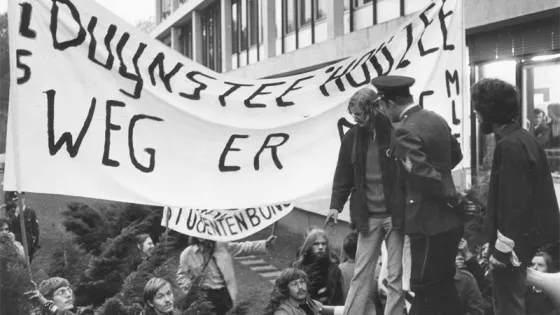
In the history of Radboud University, the months of May and June 1969 are generally classified as turbulent. That spring, the usually peaceful academic life at what was then still called the Catholic University of Nijmegen was suddenly disrupted by two months of ‘revolution’ – at least that was what it was called at the time. A rapidly growing group of rebellious students had decided to overthrow the existing university governance model, which was indeed far from optimal. They demanded transparent policy and participation for all ‘echelons’ of the university: from professors and other academic staff to the administrative support system, which was extremely varied, and of course the students themselves. To back up their demands, the rebels held protest actions: they disrupted an international conference, occupied the auditorium and turned it into a ‘permanent discussion centre’. Students gathered there and elsewhere at the university in numerous mass meetings to discuss how to proceed. Tensions ran high. In fact, the university rector, Sijward Baron van Wijnbergen became so despondent from endlessly navigating between idealistic revolutionaries and troublemakers that he submitted his resignation in June – a unique event in Dutch academic history.

Student protests from Tokio to Paris
The background of the ‘revolution’ is well-known. During the second half of the 1960s, a crisis emerged at universities around the world that was manifested through student protests, most notably in Tokyo, Berlin, Berkeley and Paris. All this was related to a general feeling of discontent, a crisis of authority and the emergence of a new, individualistic youth culture. In the late 1960s, this wave of protest also reached the Netherlands, where leftist student groups – not least at the Catholic University of Nijmegen – became increasingly critical of the existing university system and of academic practice ‘in the service of capitalism’. The recent shift to mass higher education contributed significantly to this discontent. The universities had virtually exploded in size. For example, from 1960 to 1968 the Catholic University of Nijmegen had grown from three thousand students to almost ten thousand. In May 1968, the month of the Paris revolt, university cities in the Netherlands had remained relatively quiet, Nijmegen included. The prevailing discontent led primarily to consultations between student groups and administrators, which were led by ‘meeting tigers’. Exactly a year later, however, things got out of hand. Students in Tilburg, also a Catholic university, lit the fuse to the proverbial powder keg. On 28 April they occupied the main building and painted ‘Karl Marx University’ in large letters on the façade. Nijmegen soon followed with the occupation of the auditorium. Subsequently, students at other universities also took action, the best known being the Maagdenhuis occupation in Amsterdam, from 16 to 21 May, 1969. Ultimately, the tempers calmed down somewhat at the beginning of July, when the Minister of Education submitted a new bill and the Nijmegen university board announced an experimental phase of democratisation in the spirit of this new law. But the student protest movement continued to be heard until well into the 1970s. By then, however, it had disintegrated into various left-wing political factions, which were also fighting each other. The solidarity was never greater than at the beginning, in May and June 1969.
Unique audio recordings found in archives from a legacy
The events of these months have been extensively documented in stencils, reports, pamphlets, meeting documents and newspaper reports. And, unknown to most, in audio recordings. Recently, several audio tapes were found in the legacy of Ad van der Vaart (1923-2019), who during his long career had worked various positions at several faculties at Radboud University. These recordings have now been digitised and are stored at the Katholiek Documentatie Centrum (Catholic Documentation Centre). It is unclear how Van der Vaart obtained the recordings and what purpose they served. The tapes contain a mishmash of events: parts of a three-day conference of the national Physics and Medicine Conference held in Nijmegen in March-April 1967, a meeting of the Theology Faculty Council in the mid-1970s and part of a mass meeting held late at night on 19-20 May 1969 in the canteen of the Faculty of Mathematics and Physics.

Several excerpts from that last meeting can be heard here. Van der Vaart's tape recording lasts more than two hours. That too was only a fragment; the meeting itself lasted a full 12 hours, according to some sources. Rector Van Wijnbergen had called the meeting at the insistence of students. About a thousand people attended, mostly students, but also a few professors, including the Rector himself, and other staff members. The topic under discussion was rather complicated and legalistic (and apparently not very exciting): to call a university-wide meeting for all echelons, with decision-making powers. According to one of the proposals, a ‘technical committee’ should make the preparations for that meeting.

Remarkably few voices of female students
When listening to the excerpts in 2021, at least two aspects immediately stand out. Firstly, remarkably few voices of female students can be heard. Even though there were 2,000 female students in Nijmegen at that time, they kept quiet. Despite this substantial number, half a century ago the university was still a male stronghold, also in revolutionary circles. Secondly, despite its extreme length and the fatigue that must have affected many participants, the meeting was generally very orderly. The participants did not interrupt each other and they listened quietly to each other’s arguments – in contrast to television talk shows today, for example. Only occasionally was there an uproar, especially when Prof. Frans Duynstee spoke. As professor of Constitutional Law, he was the biggest stumbling block for the radical students. The rest of the time, the thousand people present at the meeting were remarkably quiet. The atmosphere also seemed to be relaxed – or is that deceptive?

Excerpt: the auditorium as central location
Students point to the importance of the auditorium as a central location for organisation and forming ideas.
Excerpt: Duynstee's appearance causes a stir
A student formulates a resolution that is put to the vote at the meeting. Frans Duynstee then takes the floor; he had only appeared in the canteen a little earlier and caused quite a stir with his intervention.
Excerpt: closing the meeting
After a long voting procedure, the resolution is adopted and the chairman wants to close the endless meeting. Jan Bervoets, student of Dutch Language and Literature and one of the ‘bosses’ of the revolution, refers briefly to the occupation of the university Senate office earlier in the evening of 19 May by hard-line students, who, however, did not receive mass support. When asked by the chairman who would like to help clean up after the meeting, the name ‘Duynstee’ was chanted from the room. However, the person addressed indicates that he would rather go to the pub. The calls and announcements from students at the end illustrate once more the unprecedented turbulence of the months of May and June 1969.
All in all, the excerpts are not always easy to listen to, but they do give the listener a historical sensation: listening to the revolution as it unfolds. How different the university was back then!
Text and selection excerpts and photos by university historian Jan Brabers.
Copyright holders are listed where known. Radboud University has made reasonable efforts to identify the copyright holders of photos in this publication. Please contact us and provide details if you believe material has been used here without prior permission.
Photo above the article: Hans Zweers