


The Education Days
In our rapidly changing society and unstable world, the question of how and for what we educate our youth arises. Do you ever ponder these questions? With the event The Education Days (18 to 21 March 2024) Radboud University, Radboudumc, HAN University of Applied Sciences and ROC Nijmegen offer an opportunity to all education professionals to think about the education of today and tomorrow. Students with educational backgrounds are also welcome.
Programme 2024
Theme: Moving together towards the future
Every morning, several workshops are organised with a strong focus on didactics. Every afternoon there is a conference to go into depth with each other and focus on specific themes. The conference opens with a joint lunch and a stimulating warm-up. After this, you can participate in various activities such as lectures and workshops. The day ends with a cooling down and third half (drinks). Between the workshops, there will be plenty of time to change locations and network. This is how we move together towards the future!
- A draw for students: Monday afternoon on the campus of ROC Nijmegen. Focusing on inclusive education, internship discrimination, student well being.
- Society as a playing field: Tuesday afternoon on the campus of Radboud University. With topics such as sustainability, citizenship and inclusion.
- Digifit in education: Wednesday afternoon at Radboudumc Experience Centre. With topics such as AI in education, open education and Extended Reality.
- Teachers in balance and in motion: Thursday afternoon on the campus of HAN University of Applied Sciences. Focusing on intervision, art and teacher development. The Education Days conclude with an education dinner at ROC Nijmegen.

Workshop hosts speak up
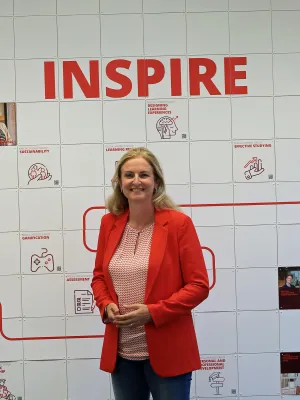
It is imperative that young people already learn to look beyond their own borders and cooperate with other educational institutions during their education
She has the honor of kicking off The Education Days this year. Marit Rensink, coordinator of the Teaching and Learning Center at Radboud University, will host the opening talk show ‘Education Coffee: the importance of networking' on Monday, 18 March, together with her colleagues from HAN and ROC Nijmegen. The aim is not only to learn from each other, but especially with each other.
‘As a society we are facing complex issues, for which cooperation between all kinds of disciplines is becoming increasingly important. Therefore it is necessary that young people learn during their education to look beyond their own borders and to cooperate with students from other educational institutions. Teachers have an important role in this: cooperation with colleagues from other educational institutions is also essential for them. Not only to learn from each other, but also to learn with each other in the future.
During the talk show in the teachers' lounge, in a café setting, I will discuss with my parallel colleagues Erik Heijmans of the HAN and Irene Wannet of the ROC why networking and knowledge exchange is so important. Erik is setting up a Center for Teaching and Learning at the HAN, Irene is coordinating the start-up of such a same center at the ROC. We would like to tell in the talk show that with such a center, all three of us have a hub where teachers can go if they want contact with teachers from the other educational institutions on a specific subject. We also want to emphasize the importance of networking and interdisciplinary education. One way we do this is by explaining the existing alliance between the university and college, with the ambition to have every student interact with a student from the other institution at least once during their studies.
The talk show is with an audience, so I expect interaction with the audience. The talk show can also be followed live via Microsoft Teams. I think the great thing about The Education Days is that we as educational institutions can learn from each other through cross-pollination. I myself focus particularly on teacher professionalization and the development of education. Hence, looking at the program, I am especially curious about the warm-up and keynote with experience designer Nils Roemen, who on Wednesday March 20th will address the use of stimulating design in education and the influence of Artificial Intelligence (AI). Furthermore, I have already signed up for the education dinner on Thursday evening, March 21, at the ROC, where we can exchange teacher knowledge and experiences in an informal and approachable way. This could be about all kinds of working methods, the use of tools, forms of discussion and research into education. A lot is happening at all three institutions: it is extremely valuable that we can combine all the knowledge and learn from each other during The Education Days. So the program offers something for everyone.'
Talk show Education Coffee
What can ROC, HAN and RU learn from each other? Why is the connection between the education institutions so important? Irene Wannet, Marit Rensink and Erik Heijmans are all three actively working on working together, bringing teachers and education professionals together to increase the quality of education. A conversation about motives, cooperation and educational quality as the kick-off of Education Days 2024.
Date and location
Monday 18 March 09:00 - 09:45. You can attend the talk show at TvA 1 or online.
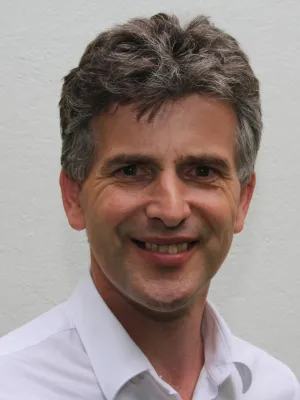
Current students need more variety in lectures. Hackaton offers opportunity to increase student engagement
Purposefully getting new ideas with a group of students in a short time, without getting bogged down in divergent discussions. Nanne Migchels, associate professor of Marketing at Radboud University, will demonstrate that it can be done during The Education Days. He will do so with the workshop 'Full throttle action: Hackaton as tool for learning and bridge a to practice'.
'Because you can achieve more as a teacher by looking more broadly than just at the usual forms of education. Today's students need more variety and forms of work, apart from the lectures and seminars. A Hackathon can be such a form of work. With a Hackathon, you bring a number of people into the same room and offer them a structure, with a maximum length of time, to get them to look at the same problem in a non-conventional way. For example, it can help to ask attendees what their personal definition of the problem at hand is. That variety of definitions then allows them to think "Out of the box" and look more broadly for a wider variety of solutions. In the Netherlands, we are used to focusing immediately on agreeing on the solution direction, rather than first identifying all solution options. So with a Hackathon we reverse that order: first exclusively generate ideas and only then determine what a possible solution direction could be.
With a Hackathon it is possible for teachers to increase student involvement in a subject. It is also a working form that allows you to use creativity in a different way. I myself regularly apply Hackathons in education. I do that in the subject Business Development, part of the master Innovation and Entrepreneurship. At my request, I invite companies or social partners to bring in a problem, after which I spend (part of) a day with students coming up with creative ideas and solutions. The time pressure keeps you from endlessly discussing ideas. It is nice to then see students continuously focused and contributing during the agreed time period. That brings about an experience of success. During The Education Days I will explain in my interactive workshop exactly what a Hackathon entails, what my experiences with it are and offer a template with steps how you can apply a Hackathon in education. I will also explain why the management of a Hackathon is especially important.
For me this will be the second time that I participate in The Education Days. I think it is incredibly valuable that we get the opportunity to look over the hedge at fellow teachers and learn from their knowledge and experiences. It is essential for us as teachers to keep our knowledge up-to-date and constantly gain new insights. Looking at this year's program, I particularly like the workshop on gamification and the sections on Artificial Intelligence (AI). The world is changing and as educators we need to keep up with that. The developments in artificial intelligence, for example, are moving incredibly fast. If you as a teacher do not think about the consequences now, your teaching topic will no longer be relevant in a few years. So innovations in education are now more important than ever.'
Nanne Migchels is one of the nominees for the University Education Awards, which will be presented on 20 March 20 during The Education Days.
Workshop Full Throttle action: hackathon as a tool for learning and a bridge to practice
Hackathons are often used in ideation processes. They provide a structured approach to generate ideas to develop a solution. Time pressure is the key ingredient of a hackathon, this helps generate ideas rather than divergent discussions. This session will help you understand the concept of a hackathon, how it helps connect students with wicked problems from the real world. Above all, we will let you experience what it is like to be part of a hackathon so that you can reflect on its added value.
Date and time
Tuesday 19 March from 11:00 - 11:45 at the Heyendaalseweg 141 (Elinor Ostrom building), room N01.610.

We want to show how to weave game concepts into your teaching and help you as a teacher get started with it
There is still plenty to discover to enrich education. Mark Graner, team member of Educational Design & Technology within Education Support at Radboud University, hopes to offer teachers new insights during The Education Days. He will do so with the workshop 'Pimp Your PowerPoint' and with a session on the use of game elements in education.
'You may recognize it: a PowerPoint with many sheets, filled with extensive text. The idea behind this is often to make the presentation also serve as a reference work for students who cannot attend the lecture. An understandable reasoning, although such sheets distract from your story. You do more justice as a lecturer or researcher if your presentation supports your story in the background. Using more images and less text helps. But how do you go about this? The workshop 'Pimp Your PowerPoint' gives you practical tools to deal differently with the content of your presentation, based on topics such as contrast and use of color. All this to positively influence the attention of your audience and get your story across in the best possible way.
I am also part of the Games & Education special interest group. During The Education Days, the four of us will be hosting sessions around the roundtable discussion on Wednesday, March 20, on the use of board and card games in education. We will have games ready to play and discuss. These are partly existing board games, partly board games developed specifically for education. Using games can help gain new insights, in group dynamics, for example, or better understanding of complex issues such as democracy or sustainability. As a special interest group, we want to show how to weave game concepts into your teaching and help you as a teacher get started with that.
For me, this will be my second year attending The Education Days. Last year I experienced that you can easily and quickly gain new insights and that the workshops help you to actually put them into practice. Looking at the program this year, the new minor 'Energy Innovations: a planetary perspective on challenging learning' seems interesting to me, as does the workshop 'Art as a driver of teacher development'. I like to be surprised, and I am particularly curious about themes that are unique and current. With our Team Educational Design & Technology, we work for all faculties to arrive at creative and innovative educational products with teachers. The Education Days help with that.'
Workshop 'Pimp Your Powerpoint'
Do you use PowerPoint for your education, but do you lack the skills to create great presentations? Let's take your PowerPoint knowledge to the next level and take a different approach to designing presentations! In this session, we will discuss the purpose of PowerPoint presentations and how slide design affects student's attention and learning outcomes. Based on examples from real courses, we will discuss the creative and proper use of text, images and colour. You will go home with inisghts and practical tips on topics like contrast, copyright and color picking, amongst others. And if you want to apply them on the go: bring your laptop and PowerPoint application!
Date and time
Wednesday 20 March on 13:15 - 14:30 at the Experience Centre of Radboudumc (Geert Grooteplein Noord 15), room -1.123, Snelbinder (route 5).
Workshop 'Physical and digital games for learning'
Games are a great way to encourage reflection, skill development and learning! In this session, we bring together a collection of physical and digital games, both ready-made and self-developed, to stimulate a wide range of learning objectives. These include collaboration, political theory, biological inheritance, communication, moral reasoning and more. Participants will have the chance to play the games and discuss how they can be used in teaching. Moreover, participants are welcome to bring their own games to add to the showcase, so we can all play and learn new games together!
Date and time
Wednesday 20 March at 14:45 - 15:45 in the Experience Centre of Radboudumc (Geert Grooteplein Noord 15), Central Hall, floor -1.

Developing agility requires a different role and a new way of guiding teachers. After all, you are no longer the only expert when working on complex issues.
How do you stimulate the development of adaptability in students so that they can deal with new, unusual and complex situations in practice? That's what the workshop 'The development of adaptability through workplace learning in higher education' will be about during The Education Days, scheduled for Tuesday, March 19. Wietske Kuijer-Siebelink, Professor responsive vocational and professional education at HAN University of Applied Sciences and researcher at Radboudumc Health Academy, will tell more about it together with Tanja Tankink, senior educational advisor at HAN UAS.
Wietske: 'It happens more and more often that in working life you have to deal with new, complex and unexpected situations. Situations, for which you are not or hardly prepared for during your education, for which no protocols or guidelines exist, but in which you still have to act. For the past four years, together with various Higher Educational Institutes, we have been investigating in the research program Adapt at Work, how students can develop that adaptability in work-based settings.’
Tanja: 'That research shows, among other things, that you can stimulate the development of that adaptability by working with 'open-ended', authentic assignments, by offering appropriate guidance and by consciously investing in learning (from) collaboration. We translate these insights into practical tools that you as an educator can apply, together with students. During our interactive workshop we not only explain the content and importance of adaptability, but we also get to work with one of those tools.’
Wietske: 'Developing adaptability requires a different role for teachers and a new way of guiding . After all, you are no longer the only expert when working on such new, complex issues. Take health care as an example: there are more and more patients with complex problems, which no longer require a single solution but a mix of knowledge and expertise. This requires not only the ability to work together, but also to act on the basis of input from other people's knowledge and expertise, and sometimes develop ne ways of working in this. Furthermore, consider the rise of Artificial Intelligence (AI), which is having an impact on various professions. What does that mean and how do you deal with it?’
Tanja: 'During workplace learning, students are no longer exclusively in the role of student: they are at work in the role of professional, depending on the issue, often interdisciplinary and always in interaction with stakeholders. This also requires adaptability. To support them in this, educational teams should have attention to characteristics of the work-environment and task characteristics related to guidance to stimulate adaptability development.’
Wietske: 'Although the research program Adapt at Work focuses on higher education, teachers from vocational education are also welcome at our workshop. It seems interesting to enter into dialogue with each other, since their students also encounter new, unusual and sometimes complex issues in practice. The Education Days are all about learning from, with and about each other, from different educational institutions and sectors. Looking at the other workshops, the workshop 'PACE' appeals to me: about a future-proof education concept for healthcare education. Furthermore, the days offer a great opportunity to strengthen educational collaboration in the region and make connections with the professional field.'
Tanja: 'The great thing about The Education Days is that they are organized jointly by the university, the professional and vocational education. The program is close to the context of the various educational institutions, so that knowledge is meaningfully shared and new connections are created. Connections that you can take into your education of tomorrow.'
Workshop 'Developing agility through workplace learning in Higher Education'
Professionals increasinlgy encounter new, unusual and complex situations in their work. In our education we need to train professionals who are able to respond to these situations, also called agile professionals or adaptive experts. In this workshop you will get insights into how to stimulate the development of agility through (new terms of) workplace learning, based on the results of the research Adapt at Work. After an introduction about agility, you will work in subgroups with one of the developed tools that can help promote agility in students.
Date and time
Tuesday 19 March from 11:00 - 11:45 at Radboud Teaching and Learning Centre (Thomas van Aquinostraat 1), room 00.36 (Teacher lounge).

Keynote Rutger van den Berg
How do young people view social issues?
Researcher and consultant Rutger van den Berg works at Youngworks and has been researching youth trends and youth culture for over 11 years. He is particularly interested in the interaction between young people and adults, because do we still understand each other? In his keynote, he gives an insight into the world of young people and their motivations. Based on research at Radboud University, he shows that young people deal with the climate crisis in very different ways.
Keynote Tuesday 19 March, 12:30 - 1:15 PM, Theater Hall C (Heyendaalseweg 141)
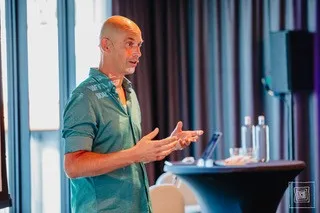
Keynote Nils Roemen
The power of human contact
Nils Roemen is also one of the guest speakers. He is fascinated by Artificial Intelligence (AI) and lets you experience that nothing will be the same anymore with its rise. In his keynote, he explains how AI is taking over our existing working practices and will render our education useless. There is no going back. Unless we start using our unique human attributes to their full potential.
Wednesday 20 March, 12.15 AM - 1.00 PM, Radboudumc Experience Centre (Geert Grooteplein Noord 15)
Download the mobile app
After you have signed up, we encourage you to download our mobile app. The mobile app is both your digital programme overview, route planner to the locations and also your ticket to the activities. You can sign up and off of activities at any time via the mobile app.
Participant's experience
In this video, participants tell about their experience during the Education Days and what the activities and conversations can bring you.
Contact us
The Education Days are organised by the Radboud Teaching and Learning Centre, the Radboudumc, HAN University of Applied Sciences and ROC Nijmegen. Would you like to know more about The Education Days or do you have a good idea? Please do not hesitate to contact us.
In the privacy statement you can read how we protect your personal data.