
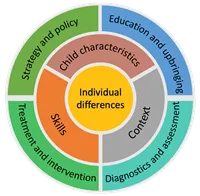
The Learning, Education, and Development group conducts fundamental and applied research on individual differences in learning and development of children, teenagers and adolescents. The core characteristics of our research are visualized below.
Learning, Education and Development
Research group


Research
Our research relates individual differences in learning and development to characteristics, the knowledge and skills individuals have to acquire, and the context in which their learning and development occur.


Individual Differences
Individual differences lie at the heart of our research. We study variations between and within homogeneous age samples to describe, predict, and explain how people learn and develop. We focus on both typically developing groups and samples with atypical development in one or more areas (e.g., attention deficits, visual impairment, coordination disorder, giftedness).
Application areas
The doughnut chart’s outer ring represents our research’s main application areas. Each area has specific themes prompted by academic or societal relevance, shaping the research questions we seek to answer. Examples include differentiated teaching, learning, treatment, and intervention forms, adaptive and dynamic assessments, and policy measures regarding equal opportunities and inclusive education.
Child characteristics
Child characteristics include a person’s cognitive, behavioural, affective, psychomotor and social-emotional attributes. We examine how such personal traits influence learning and development through longitudinal and correlational research. To illustrate, our previous research established that children’s science learning differences depend on their executive functions and reading comprehension. Other studies found that motivational differences are related to successful physical rehabilitation and that giftedness is a poor predictor of academic achievement.
Knowledge and skills
Knowledge and skills refer to the discipline or domain in which our research is embedded. We usually focus on the school subjects of language, math and science but also address motor and domain-general cognitive skills such as self-regulation, problem solving and creativity. We use longitudinal and cross-sectional designs to study whether and how learners differ in their proficiency and development of these skills. We also conduct intervention studies to determine how this development is effectively promoted through instruction and guided practice.
Contextual factors
Contextual factors relate to the physical and social environment in which learning and development occur. Learning occurs mainly in schools by interacting with teachers and peers; treatment is given in clinics by therapists, and at home, parents, siblings and friends play an essential role in youngsters’ development. By considering these situational characteristics, we aim to give a complete picture of how learning and development occur and differ between individuals.
Contact information
Location
Visiting address
Thomas Van Aquinostraat 46525GD Nijmegen
Postal address
Postbus 91046500HE NIJMEGEN