
Recharge overview

'Remembering Holland is actually more about Gelderland'
Het verhaal van Gelderland (The Story of Gelderland), edited by Dolly Verhoeven, was published on 10 November. The authors, including several Radboud researchers, describe the history of Gelderland in four sections, from a cultural, economic, political and social perspective. 'Few Gelderlanders feel a real Gelderland identity, even though there is plenty that connects us '

'Insects need our help in a warming world, now'
If no action is taken to better understand and reduce the impact of climate change on insects, we will drastically limit our chances of a sustainable future with healthy ecosystems.’ This warning comes from 70 scientists from 19 countries around the world in today’s topical paper in Ecological Monographs. Luckily, they also provide ways to help insects in a warming world complete with management strategies.

'We have to look beyond ethnicity'
Hanna Carlsson, onderzoeker bij de afdeling Geografie, Planologie en Milieu, schreef een proefschrift over de manieren waarop zorgpraktijken zijn afgestemd op de behoeften van oudere migranten in Nijmegen en Den Haag. Ze pleit voor een lokale en toekomstgerichte aanpak en hoopt dat beleidsmakers ophouden met het problematiseren van verschillen in achtergronden. “Migratiegerelateerde diversiteit kan ook een bron van zingeving en betrokkenheid zijn.”

Is reducing consumption the ultimate solution?
Radical solutions are needed in order to combat further climate change — this is nothing new. But who should make the first move and how remains unclear. Governments are increasingly calling on consumers to make sustainable choices, which begs the question: is reducing consumption the ultimate way to stop climate change? Two young economists discuss.

Do you speak body motion?
In Canada, dancers and researchers collaborated to develop dance as the universal body language for interacting with people suffering from dementia.

Five questions about vaping and e-cigarettes
There is a lot of debate at the moment around the use of e-cigarettes, also known as ‘vaping’. Peadiatric pulmonologist Peter Markus answers five questions about vaping, and how it affects our health.

Positive language reduces anxiety among patients with unexplained symptoms
General practitioners regularly see patients with persistent physical symptoms (PPS) that have no clear explanation. These patients often feel misunderstood. But the researcher Inge Stortenbeker, who will receive her PhD from Radboud University on 3 November, found that a physician’s use of language and choice of words can influence how anxious patients are after a consultation.

Forms of address in multinational job advertisements
Some languages prefer to address people formally, others informally. What about the job ads of large multinationals recruiting in Dutch, Belgian Dutch, French, Spanish and German? Language scientists at the Centre for Language Studies (CLS) found that in German - known to be a formal language - there seems to be a shift from Sie to du. 'That knowledge is particularly relevant for intercultural corporate communication.'

'We talk about walls and fences but the hardest border is made of paper’
Henk van Houtum is a Professor of Political Geography and Geopolitics as well as a cofounder and coordinator of the Nijmegen Centre for Border Research (NCBR) at Radboud University. This week he is our #Scientist of the Week.
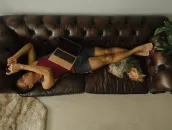
No evidence as yet that people exercise less after office work
After a busy day at the office, many people collapse onto the sofa instead of getting some exercise. The mechanism behind this phenomenon is what Sven van As explored in his PhD thesis, which he is defending at Radboud University on 2 November. “When we feel stressed or tired, we tend to go for the easy option.”
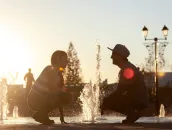
Love at first sight? The science behind speed dating
What information do we use to quickly decide whether we find someone attractive? And what happens in the body when two people find each other attractive during a speed date?

Whether you were popular or bullied says a lot about your later life
What can you learn from following a group of people from babyhood until far into adulthood? And how can you keep such a research study running successfully for so many years? Two researchers offer a look behind the scenes of the Nijmegen Longitudinal Study, which is celebrating its 25th anniversary this year. “How popular you were with your classmates continues to predict your health and job prospects years later.”

Why inspiration doesn’t grow on trees
What subconscious processes lead to great achievements? That question is the focus of ‘Inspiratie’, a new popular science book by Ap Dijksterhuis, professor of Psychology. ‘Without inspiration we might have still been living in the jungle.’

Letter Prince: a game teaches children to read better
How can you teach seven-year-olds to read better? Just let them play a game. Friday 14 October 2022 will see the launch of a new version of the ‘Letter Prince’ reading app, an online game that teaches children to read or improve their reading skills. “We don’t have to confront children with long lists of words or boring fill-in-the-blanks exercises,” said psycholinguist Esther Steenbeek, co-developer of the game.

In search of visible and invisible traces of the Cold War
Since the summer, new Radboud Heritage Fellow, cultural historian and Dutch-language scholar Linda van der Pol has been delving into the past of the university campus as it was during the Cold War. The visible and invisible traces of the Cold War that can be found on campus serve as a starting point for exploring the relationship between Eastern and Western Europe during the immediate post-war decades.

Do students consider wokeism a danger to democracy?
According to Justice and Security Minister Dilan Yesilgöz, 'wokism' is a movement that threatens the democratic rule of law. What do students think about this? Jochem Tolsma and Rob Franken, researchers at Radboud University, asked over 700 students. The majority appeared to disagree with the minister.

Children's educational attainment harmed by adverse events
Children of higher-educated parents are also more severely impacted by adverse events such as divorce or child abuse. This is the conclusion of the PhD research of Carlijn Bussemakers, who is defending her PhD thesis at Radboud University on 21 October 2022. ‘Adverse events are not only problematic for families that have traditionally be seen as vulnerable.’

WWF: Climate action needed to reverse biodiversity losses
The new Living Planet Report 2022 of the World Wide Fund for Nature (WWF) reveals that populations of mammals, birds, amphibians, reptiles and fish have declined by an average of 69% since 1970.

From ketchup to speculoos: our children are eating too much salt
‘Our children are eating far too much salt’, said pediatric nephrologist Michiel Schreuder of the Radboud university medical center in 2009 in the Dutch television program Jeugdjournaal. In the meantime, unfortunately, little has improved. His message in 2022? ‘The government should intervene now and reduce salt in products step by step. That will save an estimated 5,000 deaths a year in the Netherlands.’ Schreuder answers five questions about salt.

Nostalgia, the lighthouse of memory
Nostalgia is a deliberate and bittersweet emotion that connects us to ourselves and other people. It reminds us of the sweeter moments of our lives and the irreversibility of time.