
Recharge overview

TropIQ seeks new mosquito repellents
TropIQ Health Sciences, a Radboudumc spin-off, has received a 1.3 million USD grant from the Bill & Melinda Gates Foundation to track down new mosquito repellents. Agents that repel - or attract - mosquitoes could play an important role in fighting malaria, dengue and other mosquito-borne diseases. In this research project TropIQ cooperates with AI-scientists and researchers from the University of Washington.

The thin line between FOMO and a burnout
A lack of sleep, a lack of concentration, cancelling more and more appointments. These can all be signs of a burnout in the making. Many students deal with it over the course of their studies. During Radboud University’s Wellbeing Week, mental health takes centre stage.

Follow-up Research into Suriname Life After Abolishment Slavery
Slavery was abolished in Suriname in 1863. How did the people live their lives after being liberated? Did they find jobs? Who did they marry? Having previously published the slave registries, Historian Coen van Galen is now doing follow-up research on the lives of hundreds of thousands of Surinamese people after 1863.

Artemisia, re-re-discovered genius of the Baroque
The exhibition Artemisia, woman and power opens on 26 September in the Rijksmuseum Twenthe. Brilliant artist of the Baroque and unsolicited icon for feminism: her name should ring a bell with everyone. But it does not. Anneke Smelik wrote an essay about her and hopes that Artemisia Gentileschi will not be forgotten again. ‘As a feminist, I find it painful that she has to be rediscovered every time.’

'Banning cyber ransom payments is pointless'
Ransomware, phishing attempts and other cybercrime is posing a growing threat to companies. Cyber insurance was designed to help companies mitigate these risks. Insurance companies often choose to pay the ransom -- something critics claim is counterproductive. With this in mind, the Dutch government is now considering banning ransom payment entirely. According to attorney Nynke Brouwer, this is not the solution.

‘It's not too late to think differently about privacy’
We often share that information without being fully aware of it, but to a large extent, we appear to have simply accepted this, even though privacy-friendly solutions are often within reach, says associate professor Jaap-Henk Hoepman in his latest book.
The problem with swimming in Bacardi Lemon
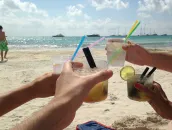
Dutch singer Mart Hoogkamer had a summer hit with his song about swimming in Bacardi Lemon. But why does the song not address the problematic increase in nitrogen as a consequence of all the sugar beets needed to fill his pool with rum? Pop artists like to sing about people's feelings coated in a thick layer of drama. But if you're hoping that The Weeknd is going to bring us a song about a one-night stand during a Canadian 'heat dome', it's probably better not to hold your breath. It's high time for climate pop music!

How the spiral of terror has changed our lives since 9/11
This month, it is twenty years to the day since the attack on the World Trade Center took place. What followed was the ‘War on Terror’, an unprecedented global fight against terror. It is a war that has cost hundreds of thousands of lives and trillions of dollars, a war that many believe has led to the global curtailment of human rights. Willemijn Verkoren, associate professor at Radboud University’s Center for International Conflict Analysis and Management (CICAM), sums up the past twenty years in her new book and discusses how we can possibly break out of the terror rut.

How do languages of bilingual children influence each other?
Bilingual children sometimes say things a little differently than monolingual children. For example, a French-Dutch child may ask: ‘Why you cry?’ An acceptable word order in French, but ungrammatical in Dutch. Chantal van Dijk investigated whether such influencing between languages also takes place in the understanding of sentences.

Why you’re not able to tickle yourself
If someone else tickles you, it feels much more intense than when you try to tickle yourself. This is because your brain is already predicting what your own tickles will feel like.

Medical journals join forces to call for stricter climate regulations
World leaders must make more of an effort to combat climate change. That was the call to action published last week in more than two hundred medical/scientific journals. Professor Marcel Olde Rikkert is one of the authors of the editorial commentary.

Marker Wadden: an example of innovative nature restoration
The first five islands of the Marker Wadden have been developed. An example of a nature restoration project in which both the ecosystem services for humans and the ecological integrity of a natural area are improved, according to a team of researchers from Radboud University, the Netherlands Institute of Ecology (NIOO-KNAW) and the University of Groningen working in collaboration with the Dutch Society for Nature Conservation (Natuurmonumenten). In their publication in Ecological Solutions and Evidence, the team describes the ecological background and scientific findings of the first four years of this unique and innovative project. Plants, birds and fish quickly established in the new area.

Transfer RNA: a new drug for peripheral neuropathy?
A team of scientists led by Erik Storkebaum of Radboud University’s Donders Institute have deciphered the molecular mechanism underlying a form of Charcot-Marie-Tooth (CMT) peripheral neuropathy. This disease affects both motor and sensory nerves. This scientific breakthrough suggests a new form of treatment for this incurable disease.

‘We are the oldest city of the Netherlands – and we should show it’
To make Roman Nijmegen more visible. That’s Stephan Mols’ task as the new lecturer of the history of Nijmegen. ‘To visualise above ground what lies beneath is immensely important.’

A healthy society also requires humanity
In their book Een gezonde samenleving (A Healthy Society), scholars from Radboud University and Radboud university medical center share their insights into healthier living and working. “It’s a call for dialogue and humanity, but also an expression of it.”

Creativity and ‘madness’ often go hand in hand, just look at Van Gogh
Was Vincent van Gogh crazy? What is crazy? Would he have made such beautiful work without his madness? The link between creativity and psychological vulnerability is the central theme in the exhibition Gek van Kunst (Crazy about Art) at the Huis van de Nijmeegse Geschiedenis (House of the History of Nijmegen). 37 artists with mental issues are presenting their work. Radboud-historian Clim Wijnands wonders how normal it is to be a mad artist.

Enemy of the Netherlands: 18 stories on the consequences of a post-war royal decree
On October 20, 1944, the Dutch government declared all Germans in the Netherlands to be enemy subjects. All property was taken from them and their work and residence permits were no longer valid. The new book Dealing with the enemy (Afrekenen met de vijand) by historian Marieke Oprel contains eighteen stories of people who were given the status of enemy subject. ‘What happened back then was not something to be proud of.’

Residents of the Waalkade made their balconies available for Theophanu
The unusual life story of the tenth-century Empress Theophanu already appeared last autumn in a mural on the Waalkade. Now, partly thanks to art historian Mariëtte Verhoeven, a book has been published recording Theophanu’s life story from Eastern Roman princess to Western empress. 'Compared to the Haga Sophia, Saint Peter's must have looked a bit plain to Theophanu.'

No, app contact is not superficial
Fleur Jongepier, philosopher at Radboud University, argues that app contact is superficial.

Reaction to 9/11 did not create safety, but fear
Twenty years of War on Terror have yielded more loss than gain, argues Willemijn Verkoren. The growing fear of terror has helped terrorists achieve their goal.